Four Seasons Yachts vs Ritz-Carlton Yacht Collection: How the Two Hotel-Brand Yachts Actually Compare
July 2026

David Smith
Managing Director
The Ritz-Carlton Yacht Collection got there first, launching Evrima in 2022 after a difficult development period marked by shipyard delays, the pandemic, and a mid-project change of builder. Two sister ships followed, both properly larger: Ilma in 2024 and Luminara in 2025. Four Seasons Yachts took a different path, spending nearly five years developing a single vessel with Fincantieri, before Four Seasons I made her maiden voyage on 20 March 2026, the 65th anniversary of the day Four Seasons opened its first hotel in Toronto.
Both operators appeal more or less to the type of guest: a well-travelled luxury buyer who wants Michelin-adjacent food, an all-suite ship, a marina platform for swimming, and the reassurance of a hospitality brand they already trust on land. But that's where the similarities end. The two products approach almost everything else differently, from the number of guests on board to whether your evening cocktails come with a bill at the end.
Since we work with both brands and get asked the "which one" question with real regularity, this piece is my honest take on how Four Seasons Yachts and Ritz-Carlton Yacht Collection actually compare. If you've stayed at either brand's hotels, some of this will feel familiar. If you haven't, it's worth noting up front that both are excellent entries into the world of ultra-luxury cruising. The question is which one suits you.
At a glance
The two operators are close enough to look similar from a distance and different enough to make the choice real. Here’s how they line up:
Four Seasons Yachts
- Fleet: One ship (Four Seasons I, 2026); a second ship confirmed for 2028
Guests: 190 - Suites: 95 (entry-level from 537 sq ft)
- Fare model: À la carte, with breakfast and non-alcoholic beverages included
- Signature: Sedna and the rotating Chef-in-Residence programme
- Deployment: Mediterranean summer, Caribbean and Bahamas winter
Ritz-Carlton Yacht Collection
- Fleet: Three ships (Evrima 2022, Ilma 2024, Luminara 2025)
- Guests: 298 (Evrima), 448 (Ilma), 452 (Luminara)
- Suites: 149 (Evrima) or 224-226 (Ilma, Luminara); entry-level from 300 sq ft
- Fare model: Fully all-inclusive, including premium alcohol and gratuities
- Signature: Multi-venue dining programme overseen by three-star Michelin chef Sven Elverfeld
- Deployment: Mediterranean, Caribbean, Northern Europe, Alaska, Asia, South Pacific
Two things worth pulling out of that immediately. First, if you’re doing pure numbers, Four Seasons I is the more intimate ship by some distance: 190 guests vs 298 on the smallest Ritz-Carlton ship, and the entry-level suites are almost twice the size. Second, if you’re doing itineraries, Ritz-Carlton has the broader reach right now, simply because three ships cover more ground than one. Whether that matters to you depends on where you want to go.
Fleet and scale
Ritz-Carlton’s three-ship fleet is one of the practical reasons to choose it right now. Evrima was the first out of the gate in 2022 and still handles the smaller, more intimate itineraries. Ilma and Luminara arrived in 2024 and 2025, both meaningfully larger and both LNG-powered, which the industry cares about even if most guests don’t. Between the three, Ritz-Carlton can run Mediterranean, Caribbean, Alaska, Northern Europe, Asia and the South Pacific concurrently. That’s an impressive amount of geography for a still-young operator to cover.
Four Seasons Yachts is in a different place. Four Seasons I is the only ship in the fleet at the time of writing, with Four Seasons II arriving in 2028 and a third vessel already ordered. The inaugural season is ambitious: 32 distinct voyages across 52 sailings, calling at 130 destinations in more than 30 countries, all done by one ship, following the sun between Europe and the Caribbean. If you want to sail Four Seasons in Alaska or Japan, you’ll be waiting for the fleet to grow.
The practical question is whether fleet scale matters to you. If you have specific destinations in mind that Four Seasons doesn’t yet cover, Ritz-Carlton is the more immediate answer. If you want the newest product in the segment and don’t mind sticking to Mediterranean or Caribbean routes, Four Seasons I is available and, according to reports from clients, is actually delivering on its hospitality promise.
Worth noting: the small fleet isn’t necessarily a limitation. Four Seasons is treating this as a slow and steady build – where a solid foundation is designed to be built out into something more comprehensive and far-reaching. Ritz-Carlton scaled quickly out of necessity to justify the initial investment, which is a different commercial position.
The Four Seasons approach is closer to how they’ve historically opened hotels: build the first one properly, then open the second, then the third. It just takes longer.
Ship size and feel
Ship size matters more than it should. On paper, 190 guests and 298 guests don’t sound especially different. In practice, Four Seasons I at 190 and Ritz-Carlton Evrima at 298 deliver noticeably different experiences, and both are meaningfully smaller than Ilma and Luminara at around 450 guests each.
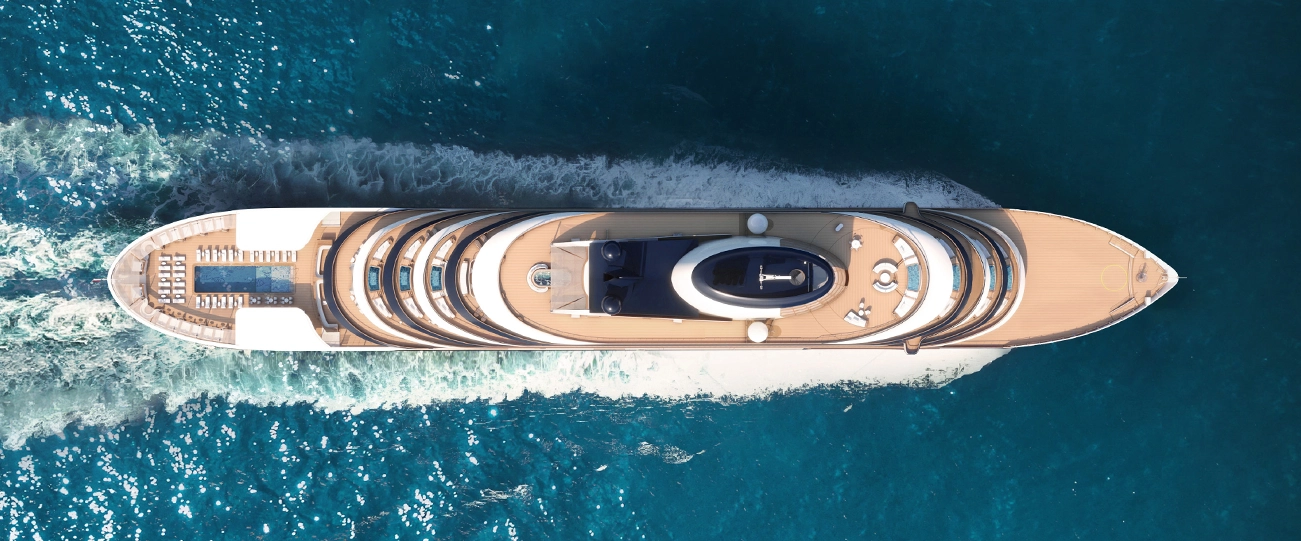
Four Seasons I is the most obviously yacht-like of the three, and the design decisions bear that out. Every one of the 95 suites is a proper suite, entry-level starts at 537 square feet, and the total guest count means you’ll see the same faces at breakfast that you saw at last night’s dinner.
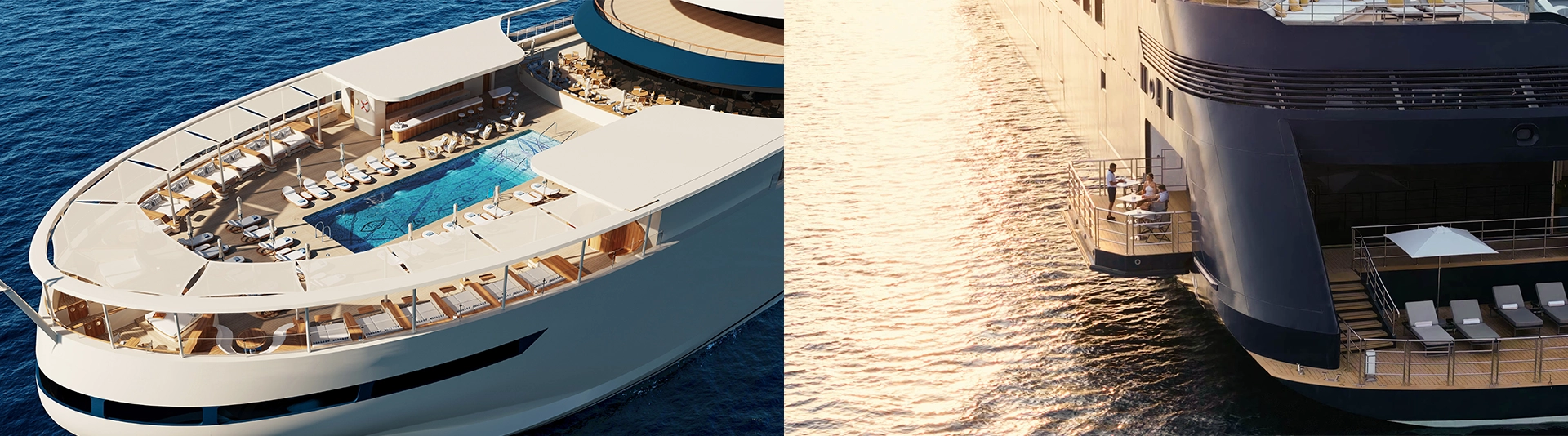
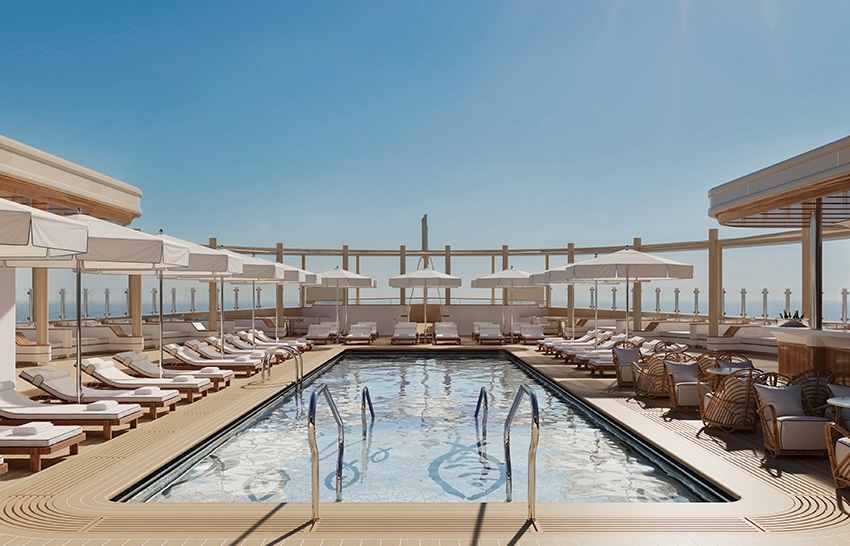
The transverse marina is absolutely one of a kind and something that some of our clients have already asked for more information about. Now, I’ve never been fortunate enough to sail on a private yacht, but if you have, then I would imagine this is the ship that will most closely capture that feeling.
Evrima is a step up in scale, though still small by cruise standards. She was the industry’s first hotel-brand-at-sea vessel, and her 149 suites and 298 guests represent Ritz-Carlton’s original interpretation of the format.
Suites are smaller than on Four Seasons I (entry-level suites start at 300 square feet), but the ship has been well reviewed for feeling intimate despite the higher headcount. Public spaces are proportionately generous, and Evrima still runs some of the most interesting itineraries in the fleet.
Ilma and Luminara are the newer, larger ships. Both are around 450 guests across 224 to 226 suites, and both have more public amenities than the smaller vessels: expanded spas, larger pool decks, more open-air lounges.
The trade-off is that both feel more like small luxury cruise ships than yachts, and the guest count changes the atmosphere. You’re less likely to know most of your fellow passengers by the end of a two-week voyage. Whether that’s a positive or negative depends entirely on what you want from a cruise.
So which size suits you? If your preference is yacht-scale intimacy, Four Seasons I is the smallest and delivers on that promise. If you want a proven hotel-brand-at-sea product with a track record but still on the intimate end, Evrima is the natural choice. If you want a slightly larger operation with more onboard facilities, Ilma or Luminara are the newer, bigger sisters. All three work, but they have their differences.

The BIG one: Pricing
This is where the two operators actually differ, and it’s the area where buyers get caught out most often. Ritz-Carlton is all-inclusive in the modern luxury sense. Your fare covers all your dining across the ship’s restaurants, an open bar with proper premium alcohol (Moët, decent wines, actual named spirits rather than generic pours), gratuities, high-speed Wi-Fi and 24-hour room service. Barring spa treatments and shore excursions, you can leave your wallet in the suite for a week and never think about it.
Four Seasons Yachts has taken the opposite approach, and it’s the boldest editorial decision either operator has made. Your fare covers breakfast in designated restaurants, non-alcoholic beverages, Wi-Fi, gratuities, watersports and the group class programme. Everything else, lunch and dinner in the speciality restaurants, alcohol of any kind, spa treatments, shore excursions, and the Chef-in-Residence tasting menus at Sedna, is billed separately or bought through curated packages. This is the Four Seasons hotel model translated to sea, and it’s exactly how you’d expect to pay at a Four Seasons resort.
There’s a second difference in how each operator prices. Ritz-Carlton charges per person on double occupancy, the standard cruise industry model. Four Seasons charges per suite regardless of how many people are in it, the standard hotel industry model. Solo travellers or three-person groups end up on very different sides of this equation depending on which operator they choose.
Yes, but how much?
Realistic starting numbers, based on current published fares. Ritz-Carlton entry-level Caribbean sailings on Evrima or Ilma run from around £940 to £1,025 per person per night on shorter itineraries. Four Seasons Yachts’ entry-level Caribbean sailings run from around £1,500 per person per night at the low end, climbing to £2,500 per person per night on higher-profile itineraries.
So Four Seasons is starting at meaningfully higher headline fares before you add anything, and once you factor in the drinks and speciality dining that Ritz-Carlton includes, the gap on total voyage cost is likely to be considerably larger.
This is worth being direct about because it’s the honest picture. Four Seasons Yachts is more expensive per night than Ritz-Carlton, and it’s meaningfully more expensive in total voyage cost. What you’re paying for is a smaller guest count (190 vs 298 or 450), roughly 80% more space in the entry-level suite (537 sq ft vs 300 sq ft), and the choice to opt in or out of premium extras rather than pay for them by default. Whether that trade-off is worth the premium depends entirely on what you value in a luxury cruise.
If space and privacy are the point of the voyage for you, Four Seasons delivers meaningfully more of both, and the premium is justified. If you want the reassurance that everything is included and you’ll never be reaching for a card during a two-week voyage, Ritz-Carlton delivers that at a lower total cost.
The Cruise Line’s Voyage Consultants can walk you through the real numbers for the specific voyage you’re considering, and it’s worth doing that before you commit either way.
Dining
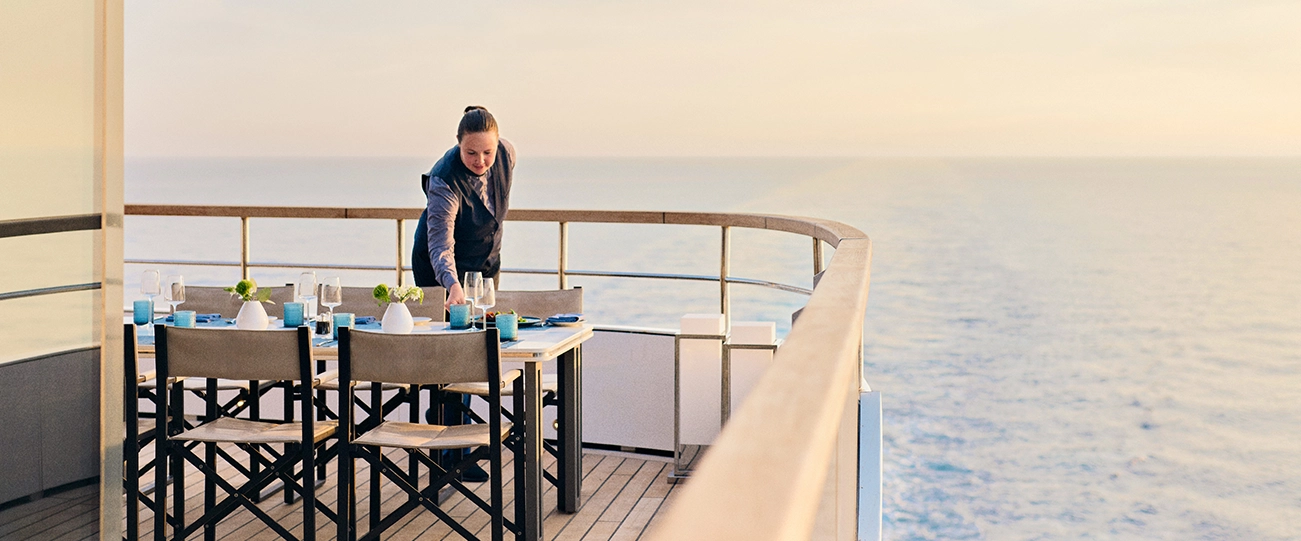
Both operators have taken dining seriously and have brought in strong kitchen credentials to make the point. But they’ve approached the culinary programme differently, and that difference tells you something about how each brand views the yacht experience.
Ritz-Carlton has built a five-venue dining programme across each of its yachts, overseen by Sven Elverfeld of Aqua in Wolfsburg (three Michelin stars, one of Germany’s most celebrated chefs). The main dining room is designed as a series of interconnected smaller rooms rather than a single mass hall, which was an architectural design choice rather than a decorative one.
The speciality restaurant on each ship, the Chef’s Table experience specifically, is where Elverfeld’s influence shows most clearly. There’s also an Asian-inspired venue, a seafood-focused restaurant and a poolside grill. On the Ilma and Luminara, the dining venues have been expanded further, with more open-air dining options and additional casual venues.
Four Seasons Yachts has taken the “concentrated culinary event” approach rather than the “spread across many venues” approach. Four Seasons I has 11 restaurants and lounges, more venues than Ritz-Carlton per ship, but the culinary programme is concentrated around Sedna as the flagship venue.
Sedna hosts the Chef-in-Residence series, which rotates Michelin-starred chefs from Four Seasons’ hotel restaurants aboard the yacht for limited engagements. The list is properly impressive: Christian Le Squer from Le Cinq at Four Seasons George V (three Michelin stars), Guillaume Galliot from Caprice at Four Seasons Hong Kong (two Michelin stars), and several others from the Four Seasons hotel network. Which specific chef is aboard varies by voyage, so if a particular residency matters to you, it’s worth checking dates before you book.
The practical difference is this. Ritz-Carlton has a fixed and consistent culinary programme; you know exactly what dining you’re getting, whichever ship you sail. Four Seasons has a headline-grabbing rotating programme, so the culinary identity of your voyage depends on which chef happens to be aboard. If the Chef-in-Residence chef isn’t a name you recognise or care about, Four Seasons’ everyday dining is where you’ll spend most of your time, and that’s a category of food more comparable to a good luxury hotel than a Michelin destination.
For food-focused travellers, both are strong. Ritz-Carlton is the more predictable, well-executed programme with a proper Michelin-starred hand behind the design. Four Seasons is the more variable programme, but with stellar guest chefs on the right voyages. If a specific chef’s residency lands during a voyage you’d want to sail anyway, Four Seasons wins on that voyage. If you want to know what you’re getting regardless of when you sail, Ritz-Carlton is the safer choice.
Suites and space
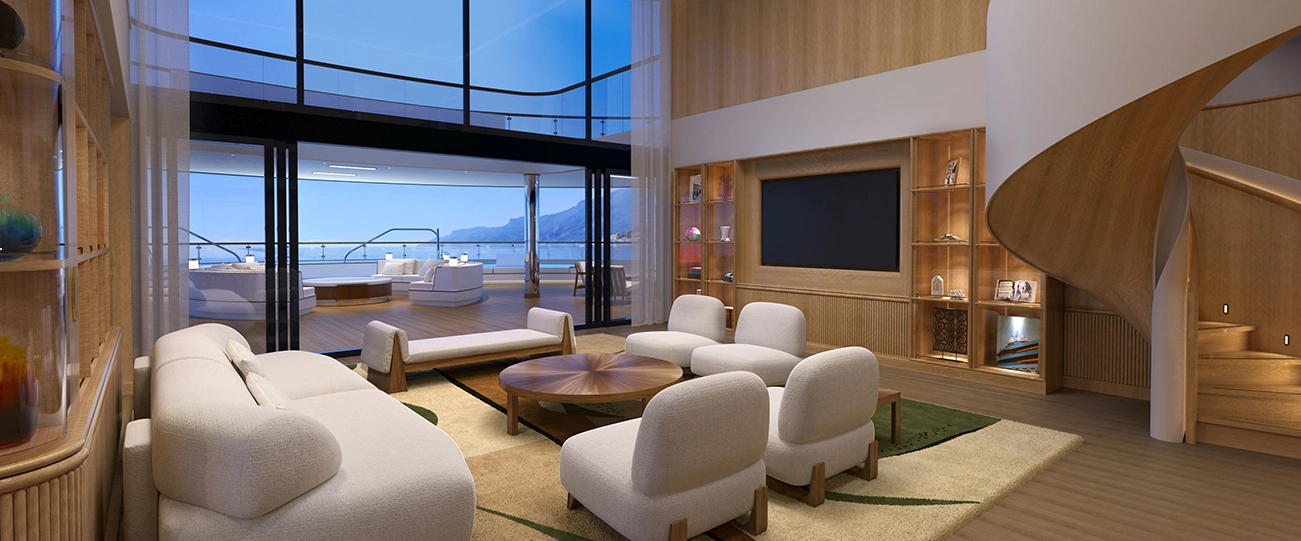
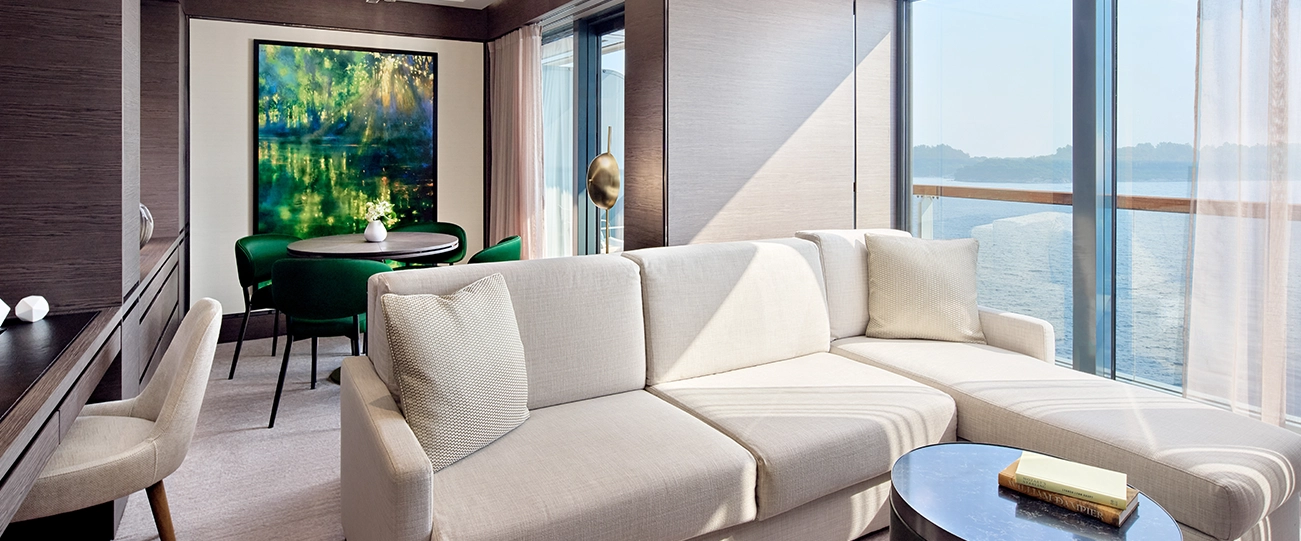
This is where Four Seasons’ premium starts to justify itself, and the numbers make the point clearly. Four Seasons I’s entry-level Seaview Suite starts at 537 square feet, including a private terrace. Ritz-Carlton Evrima’s entry-level Terrace Suite is around 300 square feet. That’s roughly 80% more space at the entry point, and it’s not marketing spin; it’s a real spatial difference that shows up the moment you walk into either accommodation.
The difference persists up through the tiers. Four Seasons I’s Ocean Suites range from 893 to 1,140 square feet. The equivalent middle-tier Ritz-Carlton suites on Evrima are smaller. When you get to the top of each fleet, though, the comparison shifts. Ritz-Carlton’s Owner’s Suite on Evrima is 1,091 square feet interior with a 635 square foot exterior, which is properly generous. Four Seasons’ Funnel Suite is nearly 10,000 square feet across four decks and represents a different order of accommodation entirely, but at that price point, you’re in a category of one anyway.
The Ilma and Luminara change the Ritz-Carlton picture somewhat. Both ships have entry-level suites larger than Evrima’s, with more of the accommodation biased toward larger categories. So if you’re doing a like-for-like comparison, Four Seasons I against Ilma or Luminara is closer than Four Seasons I against Evrima. But even compared to the newer Ritz-Carlton ships, Four Seasons still has more space per guest across the board meaningfully.
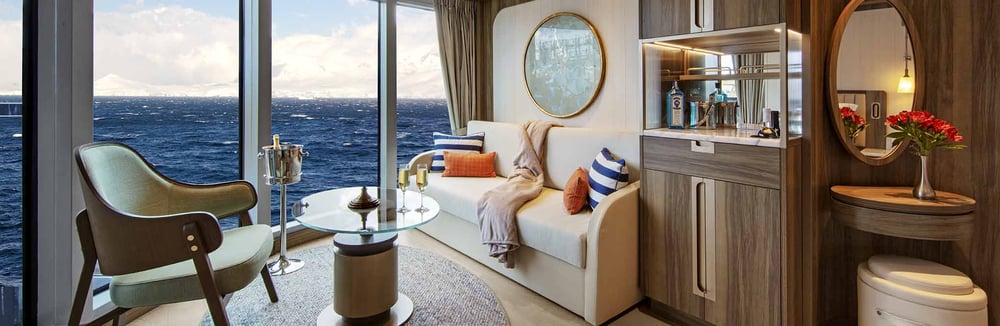
There’s a second point worth making. Four Seasons has designed its entry-level accommodation to feel like a proper suite, not a compact starter category. Even at 537 square feet, the Seaview Suite has a walk-in wardrobe, a marble double-vanity bathroom and floor-to-ceiling windows.
Ritz-Carlton’s entry-level is smaller because the ship’s design puts more space into public areas and larger suite categories rather than distributing it evenly. Both are legitimate design choices; the reader just needs to know which they prefer.
For buyers who spend meaningful time in the suite (long voyages, guests who value privacy, anyone travelling as a solo or family group where space matters), Four Seasons has an honest advantage. For buyers who spend most of their time in public areas and treat the suite as a bedroom rather than a living space, the extra Four Seasons space costs more than it delivers. The premium is real; whether it’s worth paying depends on how you actually use the accommodation.
Itineraries and destinations
If you want variety, Ritz-Carlton has more of it right now. Three ships across four continents mean the operator can run a Mediterranean summer, a Caribbean winter, an Alaska season on Luminara, and Northern European and Asian repositioning voyages in between. Their itinerary planning has also leaned harder into overnight port calls and multi-day stays than most cruise lines, which means guests get proper time in destinations rather than the eight-hour-in-port experience of a traditional itinerary.
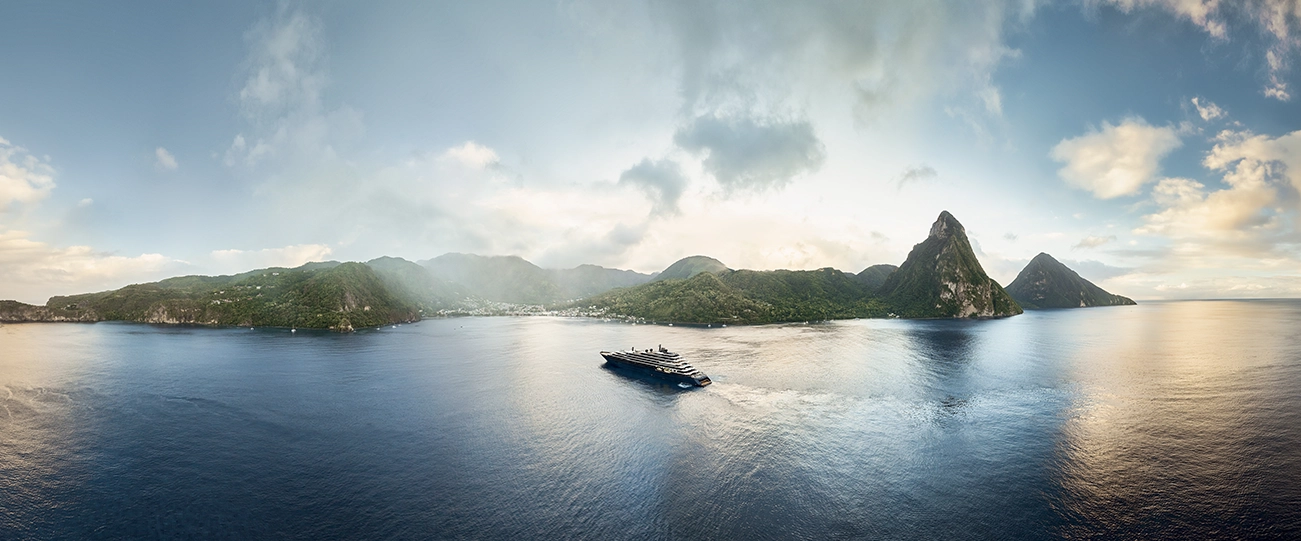
Four Seasons is more focused by necessity. Four Seasons I follows a straightforward seasonal rotation between the Mediterranean in summer and the Caribbean and Bahamas in winter. Within those regions, the itinerary design is smart. Mediterranean voyages call at properly small ports (Saint-Tropez, Bodrum, Hydra) that larger cruise ships physically can’t access. Caribbean itineraries lean into the smaller Bahamas cays and the more exclusive Lesser Antilles ports (St. Barts, Antigua) rather than the mass-market Caribbean cruise circuit. So while the geography is narrower, the specific ports Four Seasons visits within it are well-chosen.
Voyage lengths differ too. Ritz-Carlton offers a wide range, from short four-night sailings to 14-night itineraries and transatlantic crossings. Four Seasons currently focuses on seven- to fourteen-night voyages, which suit the two-week luxury cruise guest, but doesn’t offer the shorter tasters that Ritz-Carlton uses to attract first-time luxury cruisers. If you’re testing the waters (literal and metaphorical), Ritz-Carlton’s five-night Bahamas or four-night Miami itineraries are the easier entry point.
Both operators emphasise shore experiences over standardised excursions. Four Seasons, in particular, positions its shore programme around bespoke, individually curated experiences arranged by its onboard Experiences team. Ritz-Carlton’s shore excursions are more traditionally structured but include some unusual options (Nobu in Barbuda, for example, is a real included lunch experience on some Caribbean itineraries).
For destination flexibility, Ritz-Carlton wins on breadth right now. For destination quality within the Mediterranean and Caribbean specifically, both are strong. If you have a specific region in mind that only Ritz-Carlton currently covers, the operator choice makes itself. If you’re focused on the two main luxury cruise regions where both operators sail, this section shouldn’t be the deciding factor.
The verdict
Search around any luxury travel forum, and you’ll find the same debate playing out. On r/Cruise, a thread titled “What’s the point of Four Seasons?” ran to sixty-plus comments. The critics were direct. One poster, comparing Four Seasons Yachts to Ritz-Carlton, wrote that “Ritz is half the price and includes all food and drinks. Explora or Silversea are a quarter of the price and include everything.” Another pointed out that “for that price on every other line they include everything.” A third summed up the frustration: “The fact they include so little for the pricing is what’s astounding to me.”
The defenders had their own arguments. One replied: “I don’t think their market is the type of people who obsessively check to save a few dollars on their drink package upgrade. If you’re a Four Seasons regular, a $25 cocktail by the pool is normal.” Another observed that the à la carte model actually appeals to certain buyers because “they don’t want to be subsidising the high-end alcohol and caviar habits of their fellow passengers if they aren’t big on those things themselves.” A third, describing their step-mother booking Four Seasons after years of luxury cruising, noted simply that “the Four Seasons name is familiar and trusted.”
Both camps are right about what they’re right about. Four Seasons Yachts is meaningfully more expensive than Ritz-Carlton on both starting fare and total voyage cost, and that gap becomes larger once you factor in what each fare includes.
Four Seasons’ own guidance is that guests should budget around $250 per person per day for meals and drinks on top of the fare, which most buyers we’ve spoken to think is optimistic. Estimates of $350 per person per day are more realistic. On a fourteen-night voyage for two, that’s roughly $10,000 in food and drink alone before you touch a spa treatment or shore excursion.
The honest defence of the pricing, and it is a defence rather than a dismissal, is that Four Seasons is not competing on price. They are competing on the specific combination of hotel-brand hospitality, small guest counts, larger suites, and the ability to opt in or out of premium extras rather than pay a bundle.
Whether that combination is worth the premium depends on whether you value those particular things above the value proposition Ritz-Carlton offers. Some buyers will, some won’t. The Reddit thread captured that division neatly, and the same conversation is playing out at travel agency phones every day.
The most useful frame for the choice, based on how our clients actually decide between the two, is this. Ritz-Carlton is the better all-round value at almost every price point. Four Seasons is the better fit for a specific type of buyer: the hotel loyalist who already knows the Four Seasons ethos, the space-and-privacy prioritiser who wants meaningfully more suite than Ritz-Carlton offers, and the traveller who prefers paying for what they use rather than what everyone gets. Neither operator is objectively superior; they are pitched at overlapping but distinct customers with different priorities. Getting the match right is what matters.
There isn’t a right answer here, and anyone claiming otherwise is either working on commission or not paying attention. Both operators are strong products with legitimate customer bases. If Ritz-Carlton fits how you actually travel, book it. If Four Seasons fits how you actually travel, book it. If you’re not sure, talk to someone who represents both brands and can give you an honest read on which one suits you better.
Booking with The Cruise Line
The Cruise Line represents both Four Seasons Yachts and Ritz-Carlton Yacht Collection, which means we can give you an honest read on which operator fits your travel style without pushing either way. Our Voyage Consultants have detailed knowledge of both products, including specific voyages, suite categories, and the practical trade-offs between them.
If you’d like to talk through the options in more detail, call us on 0800 008 6677 or submit an online enquiry for your preferred itinerary.