Ponant to build new carbon-neutral sailing ship
May 2022
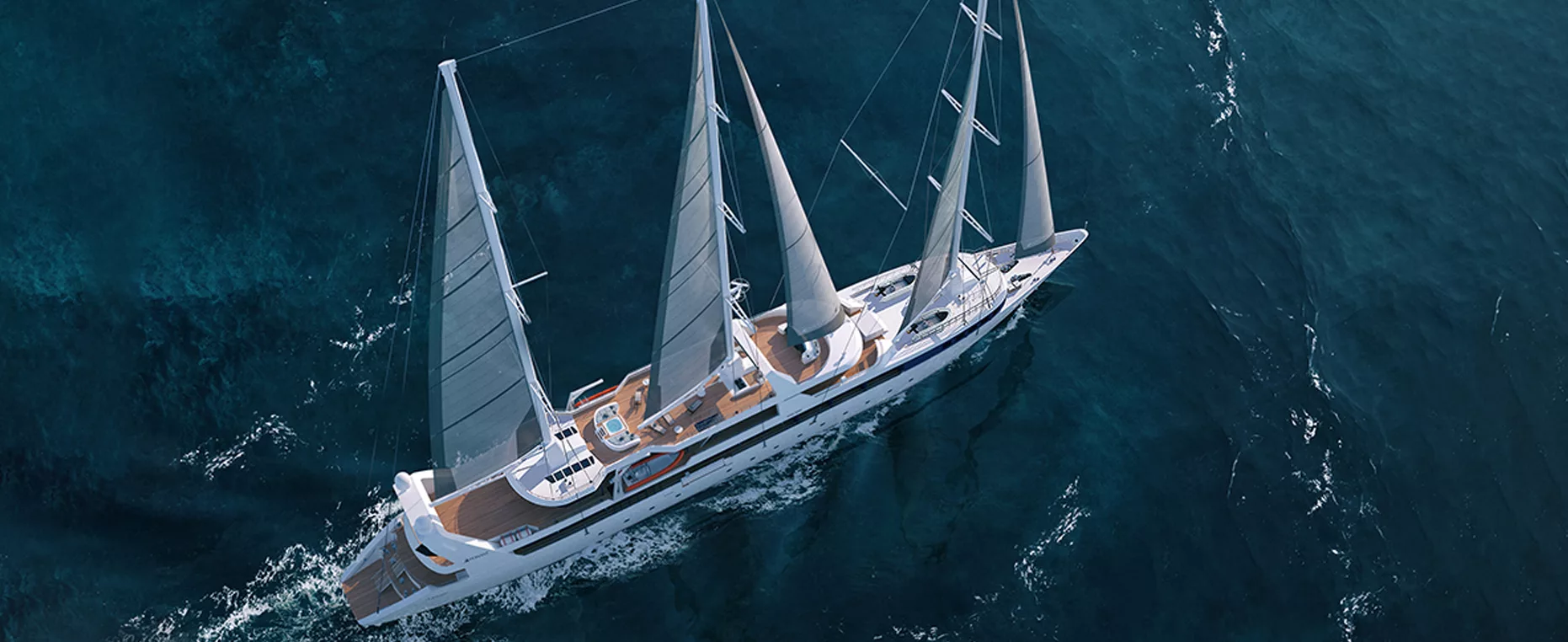
French-flag cruise operator, Ponant Cruises, has announced plans to build a new carbon-neutral sailing ship. The vessel is currently in the concept and design phase, however, the line’s CEO, Harvé Gastinel, and Director of New Builds, Mathieu Petiteau, have shared some early project details.
“We’ve been working with the STX in Saint-Nazaire, France, on developing the future Ponant sailing ship, a vessel inspired by the design and appearance of the company’s original and iconic three-master, Le Ponant”, said Petiteau. “This ship will also have a hybrid propulsion system, with engines powered not only by liquified natural gas but by a completely renewable form of energy: wind power with the fitting of a 300 m² sail.”
The vessel will be the fourteenth addition to the Ponant fleet and sail to “the extremes” of French Polynesia and Easter Island. “It will certainly be a small ship, in the 100 to 200 guest range, targeting slow travel with flexible itineraries”, Gastinel explained. “We want the most modern fleet with the best technology”, he added. “It’s a new kind of vessel. It has to be carbon neutral. It has to demonstrate the ability of the company to be at the forefront of sustainable tourism.”
Ponant has already set a benchmark for sustainable cruising. The line has offset 150% of its carbon emissions and is the first to achieve Green Marine Certification. In 2019, Ponant also became the first to abandon heavy fuel oil and switch to Low Sulfur Marine Gas Oil, which saw a 25% reduction in carbon emissions.
Furthermore, Le Commandant Charcot, the latest addition to the fleet, is the first hybrid polar exploration ship powered by liquified natural gas and electric generators. Liquified natural gas is the greenest fuel on the market, with 25% fewer carbon emissions, 85% less nitrogen oxide emissions and 95% less fine particle emissions.
Other practices Ponant have employed include:
- Limiting its average speed to 10 knots, thus reducing fuel consumption by 30%
- Having its catalytic converters running 24/7, thus reducing nitrogen oxide emissions by 75%
- Removing all disposable cups and cutlery and replacing them with reusable alternatives
- Recycling 60% of packaging (the average is 20%)
- Serving locally sourced food
- Planning itineraries with communities to avoid overwhelming small, remote populations
The line also aims to:
- Recycle 100% of waste by 2025
- Reduce carbon emissions by 30% by 2030
- Achieve complete carbon neutrality by 2050