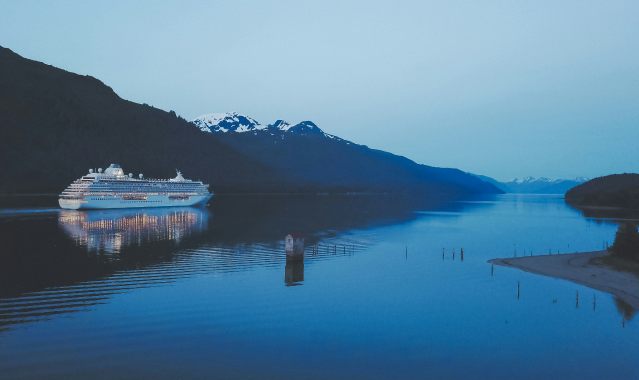
Expedition Solomon Islands, Papua New Guinea And Indonesia: Island-Hopping To Hidden Pacific Gems

 23 nights
 HANSEATIC spirit
 14 Mar '28
Cruise overview
In the Western Pacific, dream destinations await that are as idyllic as they are enigmatic. Those seeking the exceptional and who are ready to exchange the familiar for authentic experiences will find a gem of a travel destination here.
Itinerary
Auckland
Auckland is called the City of Sails, and visitors flying in will see why. On the East Coast is the Waitemata Harbour—a Māori word meaning sparkling waters—which is bordered by the Hauraki Gulf, an aquatic playground peppered with small islands where many Aucklanders can be found “mucking around in boats.”Not surprisingly, Auckland has some 70,000 boats. About one in four households in Auckland has a seacraft of some kind, and there are 102 beaches within an hour’s drive; during the week many are quite empty. Even the airport is by the water; it borders the Manukau Harbour, which also takes its name from the Māori language and means solitary bird.According to Māori tradition, the Auckland isthmus was originally peopled by a race of giants and fairy folk. When Europeans arrived in the early 19th century, however, the Ngāti-Whātua tribe was firmly in control of the region. The British began negotiations with the Ngāti-Whātua in 1840 to purchase the isthmus and establish the colony’s first capital. In September of that year the British flag was hoisted to mark the township’s foundation, and Auckland remained the capital until 1865, when the seat of government was moved to Wellington. Aucklanders expected to suffer from the shift; it hurt their pride but not their pockets. As the terminal for the South Sea shipping routes, Auckland was already an established commercial center. Since then the urban sprawl has made this city of approximately 1.3 million people one of the world’s largest geographically.A couple of days in the city will reveal just how developed and sophisticated Auckland is—the Mercer City Survey 2012 saw it ranked as the third-highest city for quality of life—though those seeking a New York in the South Pacific will be disappointed. Auckland is more get-up and go-outside than get-dressed-up and go-out. That said, most shops are open daily, central bars and a few nightclubs buzz well into the wee hours, especially Thursday through Saturday, and a mix of Māori, Pacific people, Asians, and Europeans contributes to the cultural milieu. Auckland has the world’s largest single population of Pacific Islanders living outside their home countries, though many of them live outside the central parts of the city and in Manukau to the south. The Samoan language is the second most spoken in New Zealand. Most Pacific people came to New Zealand seeking a better life. When the plentiful, low-skilled work that attracted them dried up, the dream soured, and the population has suffered with poor health and education. Luckily, policies are now addressing that, and change is slowly coming. The Pacifica Festival in March is the region’s biggest cultural event, attracting thousands to Western Springs. The annual Pacific Island Secondary Schools’ Competition, also in March, sees young Pacific Islander and Asian students compete in traditional dance, drumming, and singing. This event is open to the public.At the geographical center of Auckland city is the 1,082-foot Sky Tower, a convenient landmark for those exploring on foot and some say a visible sign of the city’s naked aspiration. It has earned nicknames like the Needle and the Big Penis—a counterpoint to a poem by acclaimed New Zealand poet James K. Baxter, which refers to Rangitoto Island as a clitoris in the harbor.The Waitemata Harbour has become better known since New Zealand staged its first defense of the America’s Cup in 2000 and the successful Louis Vuitton Pacific Series in early 2009. The first regatta saw major redevelopment of the waterfront. The area, where many of the city’s most popular bars, cafés, and restaurants are located, is now known as Viaduct Basin or, more commonly, the Viaduct. A recent expansion has created another area, Wynyard Quarter, which is slowly adding restaurants.These days, Auckland is still considered too bold and brash for its own good by many Kiwis who live “south of the Bombay Hills,” the geographical divide between Auckland and the rest of New Zealand (barring Northland). “Jafa,” an acronym for “just another f—ing Aucklander,” has entered the local lexicon; there’s even a book out called Way of the Jafa: A Guide to Surviving Auckland and Aucklanders. A common complaint is that Auckland absorbs the wealth from the hard work of the rest of the country. Most Aucklanders, on the other hand, still try to shrug and see it as the parochial envy of those who live in small towns. But these internal identity squabbles aren’t your problem. You can enjoy a well-made coffee in almost any café, or take a walk on a beach—knowing that within 30 minutes’ driving time you could be cruising the spectacular harbor, playing a round at a public golf course, or even walking in subtropical forest while listening to the song of a native tûî bird.
Read More
Bay of Islands
 At sea
At sea
Kuto Bay, Isle des Pins
At sea
At sea
Solomon Islands
At sea
At sea
At sea
At sea
At sea
At sea
At sea
At sea
At sea
At sea
At sea
At sea
At sea
At sea
Komodo Island
Benoa, Bali
Panoramic Cabin
- Heated wall in the bathroom (e. g. for towels and wet parkas)
- Rain shower
- Free mini bar (soft drinks)
- Coffee machine
- Separable beds
- Extensive infotainment with live broadcast and recordings of expert presentations, forward-view camera, navigation chart, films and much more
- Binoculars
- Nordic Walking poles
- 24-hour cabin service
- There is one cabin with fully accessible layout and equipment (cabin 404)

Amenities
- Room Service Available
- TV
- Coffee Machine
- Safe
- Hair Dryer
- Telephone
- Desk
- Double or Twin Configuration
- Lounge Area
- Free Mini Bar
- Media/Entertainment Station
- Shower
Ship features
Accomodation
Inspired by nature
In the cabins and suites, curved lines, natural colours and premium materials come together in a harmonious room concept that promises – and delivers – pure relaxation.
Features of all cabins and suites
- An ocean view with even more: exclusively outside cabins and suites, almost all with balconies or French balconies
- Spaciously designed – enjoy a relaxing stay in rooms from 21 m²/226 ft² up to 71 m²/764 ft² in size
- Exceptionally equipped – for example, with binoculars, Nordic Walking poles, air conditioning, coffee machine and mini bar (free of charge) and 24-hour cabin service
- Separable beds
- Rain shower and heated wall in bathroom (e.g. for towels and wet parkas)
- Extensive infotainment with live broadcast and recordings of expert presentations, forwardview camera, navigation chart, films and much more