- Home>
- Cruise Lines>
- Atlas Ocean Voyages>
- World Traveller>
- Lavrion to Dubrovnik
Lavrion to Dubrovnik, 30 August 2028

 7 nights
 World Traveller
 30 Aug '28
Cruise overview
Traverse three seas on a voyage that begins amid Santorini’s whitewashed villages and blue domes, where you can sip local assyrtiko overlooking the caldera. Then discover medieval Monemvasia and car-free Hydra. Transit the dramatic Corinth Canal toward the ancient site of Delphi, and explore Parga’s Venetian castle and Puglia’s villages before arriving in medieval Dubrovnik.
Itinerary
Lavrion
Santorini
Undoubtedly the most extraordinary island in the Aegean, crescent-shape Santorini remains a mandatory stop on the Cycladic tourist route—even if it’s necessary to enjoy the sensational sunsets from Ia, the fascinating excavations, and the dazzling white towns with a million other travelers. Called Kállisti (the “Loveliest”) when first settled, the island has now reverted to its subsequent name of Thira, after the 9th-century-BC Dorian colonizer Thiras. The place is better known, however, these days as Santorini, a name derived from its patroness, St. Irene of Thessaloniki, the Byzantine empress who restored icons to Orthodoxy and died in 802. You can fly conveniently to Santorini, but to enjoy a true Santorini rite of passage, opt instead for the boat trip here, which provides a spectacular introduction. After the boat sails between Sikinos and Ios, your deck-side perch approaches two close islands with a passage between them. The bigger one on the left is Santorini, and the smaller on the right is Thirassia. Passing between them, you see the village of Ia adorning Santorini’s northernmost cliff like a white geometric beehive. You are in the caldera (volcanic crater), one of the world’s truly breathtaking sights: a demilune of cliffs rising 1,100 feet, with the white clusters of the towns of Fira and Ia perched along the top. The bay, once the high center of the island, is 1,300 feet in some places, so deep that when boats dock in Santorini’s shabby little port of Athinios, they do not drop anchor. The encircling cliffs are the ancient rim of a still-active volcano, and you are sailing east across its flooded caldera. On your right are the Burnt isles, the White isle, and other volcanic remnants, all lined up as if some outsize display in a geology museum. Hephaestus’s subterranean fires smolder still—the volcano erupted in 198 BC, about 735, and there was an earthquake in 1956. Indeed, Santorini and its four neighboring islets are the fragmentary remains of a larger landmass that exploded about 1600 BC: the volcano’s core blew sky high, and the sea rushed into the abyss to create the great bay, which measures 10 km by 7 km (6 mi by 4½ mi) and is 1,292 feet deep. The other pieces of the rim, which broke off in later eruptions, are Thirassia, where a few hundred people live, and deserted little Aspronissi (“White isle”). In the center of the bay, black and uninhabited, two cones, the Burnt Isles of Palea Kameni and Nea Kameni, appeared between 1573 and 1925. There has been too much speculation about the identification of Santorini with the mythical Atlantis, mentioned in Egyptian papyri and by Plato (who says it’s in the Atlantic), but myths are hard to pin down. This is not true of old arguments about whether tidal waves from Santorini’s cataclysmic explosion destroyed Minoan civilization on Crete, 113 km (70 mi) away. The latest carbon-dating evidence, which points to a few years before 1600 BC for the eruption, clearly indicates that the Minoans outlasted the eruption by a couple of hundred years, but most probably in a weakened state. In fact, the island still endures hardships: since antiquity, Santorini has depended on rain collected in cisterns for drinking and irrigating—the well water is often brackish—and the serious shortage is alleviated by the importation of water. However, the volcanic soil also yields riches: small, intense tomatoes with tough skins used for tomato paste (good restaurants here serve them); the famous Santorini fava beans, which have a light, fresh taste; barley; wheat; and white-skin eggplants.
Read More
Monemvasía
Hydra
Corinth
Parga
Monopoli
Dubrovnik
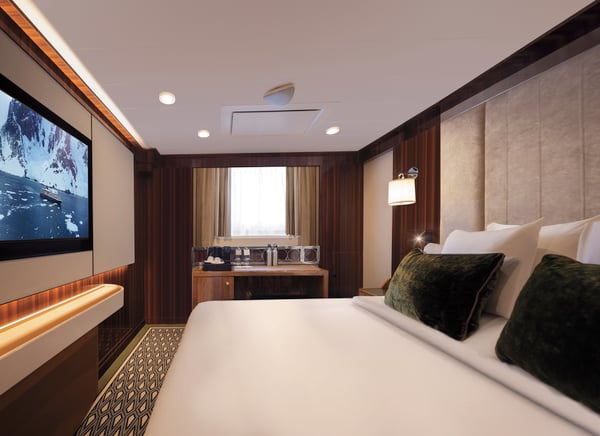
Adventure Oceanview Stateroom
Oceanview staterooms with generous windows and modern design, providing style and comfort for adventurous travellers.
Amenities
- Large window
- Sitting area
- L’Occitane toiletries
- Desk
- Minibar
- Robe and slippers
Ship features
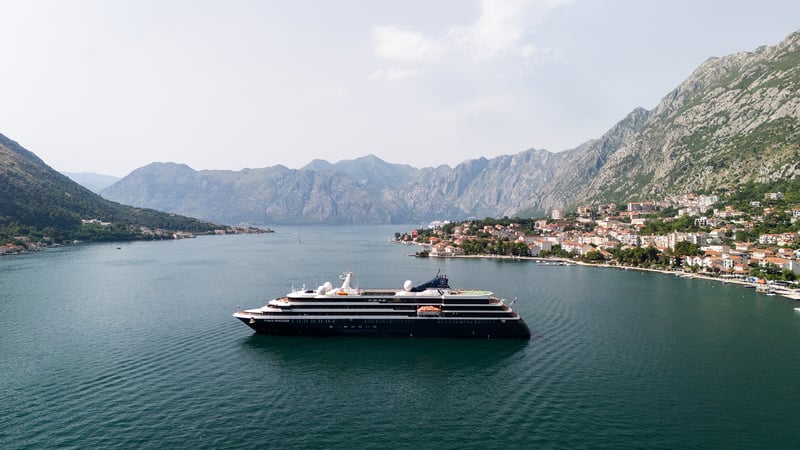
World Traveller blends luxurious yacht-style cruising with Atlas Ocean Voyages’ hallmark spirit of adventure, offering discovery without compromise on comfort or style.
- 196-guest expedition yacht
- Polar-class hull for cold and warm regions
- Nine accommodation categories, all ocean view
- Lisboa main restaurant and Alma al Fresco
- L’Occitane-partnered SeaSpa and wellness studio
- Outdoor pool, whirlpool and jogging track
- The Dome Lounge with 270-degree views
- Complimentary shore excursions and Zodiac tours
- Daily lectures and enrichment programmes
- All-inclusive dining, beverages and gratuities